

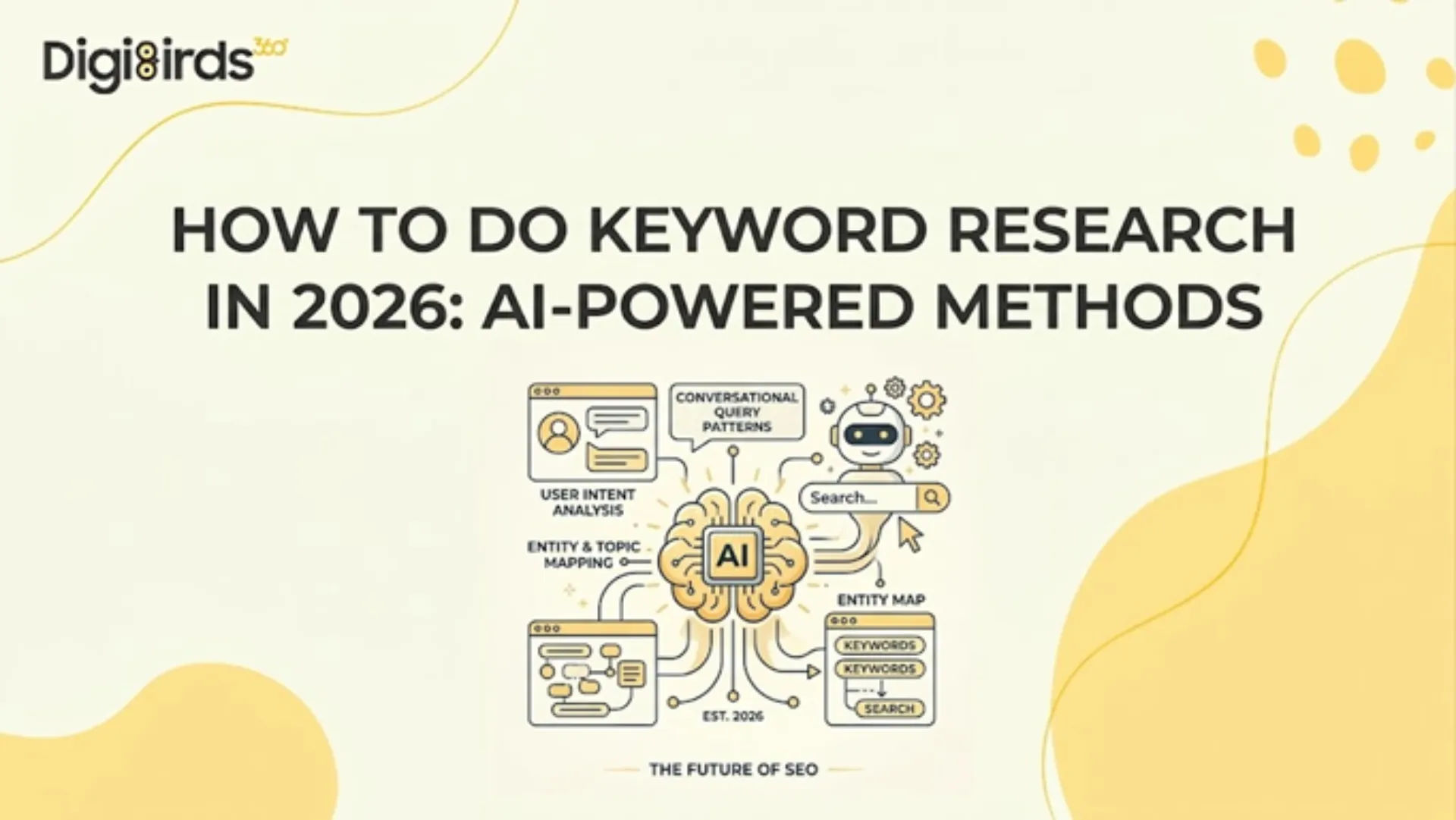
How Keyword Research Is Changing in 2026
By 2026, keyword research will not be confined to search volume, key difficulty, and phrases of exact matches. Current search engines are now being powered by artificial intelligence to gain an understanding of user intent, context, and semantic meaning. This has turned keyword research 2026 into more of a data-driven, predictive and conversational research.
The percentage of organic search continues to dominate more than 53 % of all traffic to websites, with more than 90% of the total first-page results being clicked. This renders the strategy of keywords to be among the most significant components of SEO in 2026.
For agencies like Digibirds360, adopting AI-driven keyword research is essential to improve visibility, attract qualified traffic, and remain competitive in increasingly AI-powered search environments.
Why Keyword Research Has Changed in 2026?
Traditional SEO was centred on search ranking of specific phrases like “SEO company” or “digital marketing services.” Modern-day search engines are intelligent in terms of concept and entities, and patterns of speech.
This implies that users are also using conversational phrases to search, like:
- “What is the best SEO strategy for local businesses?”
- “How can AI improve e-commerce keyword research?”
- “Which SEO tools are best for content clustering?”
Therefore, the focus of the keyword research 2026 has turned into:
- Search intent
- Semantic relevance
- Topic clusters
- Predictive trends
- Conversational and voice search
The search engines use, as well, AI-generated functions like AI Overviews, predictive search, zero-click answers and voice search. More than two out of five searches have no resultant clicks since most users usually get the answer on the result page.
Why Keyword Research in 2026 is AI-Centric?
The search engines have become answer engines. In the case of AI-generated reality, conversational search, and suggested prediction, ranking is done not based on repetition of keywords, but on a contextual basis.
Key data insights:
- 53%+ of website traffic originates from organic search
- 70–80% of clicks remain concentrated on first-page results
- AI automation reduces keyword research time by up to 67%
- Intent relevance now outweighs keyword density in ranking factors
This shift has also introduced debates like AI-powered search vs keyword search for contracts, where AI systems interpret legal, financial, and technical queries contextually instead of matching exact phrases.
How AI-Driven Keyword Research Works?
AI-driven keyword research uses machine learning, natural language processing, and predictive analytics to discover keywords more efficiently than traditional methods.
1. Identify Search Intent
The keywords are classified into categories of four intents by AI tools:
- Informational: “How to improve SEO rankings”
- Commercial: “Best SEO tools in 2026”
- Transactional: “Hire SEO agency in Delhi NCR”
- Navigational: “SEMrush login”
Recognising the intent of the search enables companies to put into focus those keywords that have a higher chance of giving leads and conversions, and not just traffic.
2. Discover Semantic Keywords
Rather than searching the same phrase multiple times, AI tools recognise similar terms and objects, enhancing topical relevance.
For example, if the main keyword is “keyword research 2026,” related phrases may include:
- AI-driven keyword research
- Search intent analysis
- Topic clusters
- Conversational search
- Voice search optimization
- Advanced search keywords
This wider strategy enhances the visibility since search engines consider the level of content and not mere repetition of keywords.
3. Build Topic Clusters
Single keywords are getting less important compared to topic clusters. One content page is expected to be supported by various related queries.
For example:
- Primary Topic: Keyword Research in 2026
- Supporting Topics:
- AI keyword tools
- Voice search keywords
- Predictive search trends
- Competitor keyword analysis
- Advanced search keywords
Such a method assists in improving ranking potential and helps search engines to comprehend the complete relevance of a page.
4. Use Competitor Gap Analysis
The current SEO tools are capable of determining the keywords that competitors are ranking that your site is not.
This, in particular, is valuable to find out:
- Untapped keyword opportunities
- Low-competition phrases
- High-converting commercial terms
- Industry-specific questions
For example, if competitors rank for "AI-powered search vs keyword search for contracts," but your website does not cover that topic, it becomes an immediate content opportunity.
5. Forecast Future Trends
One of the biggest advantages of AI-driven keyword research is predictive analysis.
AI continuously monitors trends in the search before they become very competitive. This enables the brands to post content in advance and enjoy the benefits of being a first-mover.
Some examples of emerging searches are:
- AI-powered search vs keyword search for contracts
- AI-generated SEO content strategy
- Voice commerce optimization
- Predictive search marketing
Advanced AI Techniques for Keyword Discovery
Within the framework of keyword research of the future, AI will not just occur on the extraction of keywords, but also realise more profound patterns, relations and unrealised opportunities.
These next-generation methods empower advertisers to recognise the high-impact keywords more precisely and on a larger scale:
NLP-Based Keyword Expansion
With the help of natural language processing, there are the identification of related phrases, semantic variants, and conversation search words that the users type, or utter, orally. Businesses are able to find more opportunities in wide topics rather than focus on just one query, and enhance relevance in several queries.
Does that mean, as an example, that a keyword like “keyword research 2026” can deliver such related phrases as:
- AI-driven keyword research
- Advanced search keywords
- Voice search optimisation
- Semantic keyword clustering
- Predictive SEO trends
This approach improves visibility for both traditional search and AI-generated answers.
Competitor Gap Analysis
Artificial intelligence can bring forward keywords that a competitor site has been ranking, but the site has not. It assists businesses in finding unexploited opportunities and strategically increasing their keyword footprint.
Competitor gap analysis is useful particularly in:
- Finding low-competition keyword opportunities
- Identifying missing content topics
- Discovering high-converting commercial keywords
- Improving search coverage across different stages of the customer journey
Properly employed, competitor analysis can add 20-40% of coverage in the key words used and enhance long term organic performance.
Long-Tail Keyword Optimisation
Long-tail keywords are very specific search terms, of which normally five or more words make it. They might have less traffic, but they can often provide a greater conversion potential, since they tend to be more user-intentional.
Long tail keywords have the following advantages:
- Lower competition
- Higher conversion rates
- More conformity to AI-generated responses.
- Better voice search performances.
Examples include:
- The article is titled Best AI SEO tools to use in e-commerce websites.
- How to increase the effectiveness of research with the help of AI on keywords.
- "AI-powered search vs keyword search for contracts"
Best Practices for Keyword Research 2026
In order to be successful in the area of keyword research 2026, the business should consider going beyond the usual keyword targeting and revolve its attention around:
1. Prioritise Intent Over Volume
It is not a case of the high volume of search that will yield high-quality traffic or conversions. The priorities of businesses should be on those keywords that are related to what users want to attain.
For example, “buy CRM software for small business” is often more valuable than simply targeting “CRM software”.
2. Develop Topic Clusters
As opposed to trying to optimise each page with a single keyword, build topic clustering about bigger concepts.
For example:
- Main Topic: Keyword Research in 2026
- Supporting Topics:
- AI-driven keyword research
- Advanced search keywords
- Competitor keyword analysis
3. Optimise for Conversational Queries
AI and voice search accept a natural language query that is written like a question.
Examples include:
- “What is the best SEO strategy in 2026?”
- “How to improve website ranking using AI?”
4. Localise Keywords
Localised keyword combinations are critical in case the business is region-specific.
Examples include:
- “performance marketing services Faridabad”
- “digital marketing agency near me”
5. Continuously Validate Performance
The keyword strategies are to be revisited on a regular basis in order to know what is going on and what requires improvement.
Track important metrics such as:
- Organic impressions and click-through rates
- Ranking improvements
- Conversion rates
- Engagement metrics such as bounce rate and time on page
Common Mistakes to Avoid
Despite AI-driven applications, companies do not stop committing strategic errors that trim down the effectiveness of SEO. Common issues include:
- Aggressively target high volume and low intent keywords.
- Searching through the semantic relationships between the topics was ignored.
- Not updating the keyword strategy as per the search trends.
- Using AI without human consideration and planning.
It is important to use AI insights in conjunction with the expertise of people to get good SEO results.
In Conclusion
Keyword research in 2026 no longer involves identifying the most voluminous phrases. It is all about cognition of intent, anticipating the future demand and producing the content that the AI-driven search engines will comprehend.
Businesses that adopt AI-driven keyword research can improve organic rankings, capture more qualified traffic, build stronger topic authority, adapt to conversational search trends and stay competitive in evolving search environments.