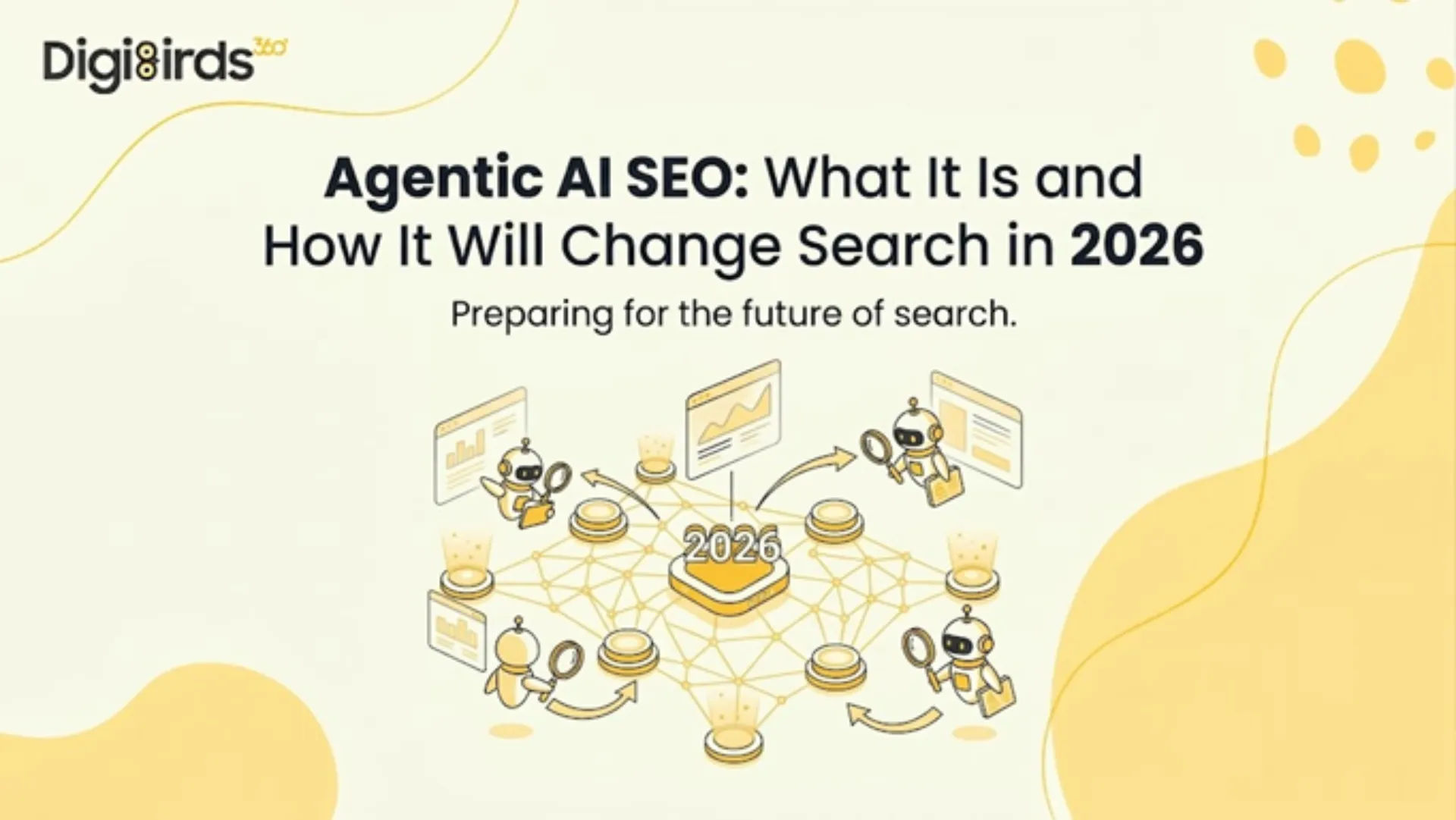
How Agentic AI SEO Is Transforming Search in 2026
In 2026, SEO will stop being a mere automation and will enter a new stage of development based on intelligent AI agents. Traditional AI tools have the potential of creating content or assisting with isolated tasks, yet they still need consistent prompting, corrections and oversight. In comparison, agentic AI SEO takes advantage of self-directed systems, which are able to plan, perform and optimise whole SEO processes with minimum human action.
In the brands that will be competing in an even more dissolute search setting, the change would alter the manner in which search strategy, design, execution and growth were developed and implemented.
The agentic AI SEO is the process of having AI agents that operate under the influence of large language models like OpenAI, Anthropic, and Google autonomously to control complex SEO operations. These agents do not just create something. They are able to study competition, research on keyword opportunities, study SERP, optimise webpage, cluster topics, track rankings, and suggest strategic measures.
What Is Agentic AI SEO?
In agentic AI SEO, autonomous AI agents (driven by large language models) are used to optimise more complicated SEO processes with minimum human involvement. Unlike traditional automation, agentic SEO systems do not simply follow instructions; they interpret objectives, make decisions, and refine strategies in real time.
These systems can:
- Competitor analysis and search analysis.
- Establish gaps in keywords and semantics.
- Chain multi-workflow tool and platform activities.
- Never cease learning from performance data.
A key distinction is that agentic SEO is not limited to generative outputs. Instead, it is a smart orchestration layer that allows the end-to-end optimisation instead of running disjointed tasks.
Why Agentic AI SEO Matters in 2026?
The weakness of standard AI tools has led to a productivity paradox in that, as things have been adopted, efficiency improvements have continued to be inconsistent. The gap is solved in agentic systems.
The studies have shown that AI based workflow is capable of:
- Reduce process efficiency through 30-50% improvement.
- Eliminate 25-40% low value human labour.
- Much reduced error rates by humans.
Also, the worldwide market of AI agents will grow from $5.40 billion in 2024 to $50.31 billion in 2030 with a CAGR of 45.8%, along with the rapid adoption of AI by enterprises.
To the SEO teams, this translates into quicker execution, enhanced understanding and scalable operations even though the resources are not increased in the same measure.
AI vs Agentic SEO (Structural Shift)
| Capability | Traditional AI | Agentic SEO |
|---|---|---|
| Workflow Execution | Manual, step-by-step | Autonomous, multi-step |
| Decision Making | Human-led | AI-assisted with reasoning |
| Adaptability | Limited | Continuous learning |
| Output | Content generation | Strategy + execution |
As an example, a content tool of standard type can create blog content. A seo optimizer ai agent, however, can:
- Identify content gaps
- Cluster keywords by intent
- Generate briefs
- Validate against SERP data
- Schedule and monitor publishing
This combined ability essentially reinvents the development and execution of the SEO strategies.
Core Components of Agentic SEO Systems
The agentic AI works based on 5 components:
1. Tools
Agents interact with APIs, analytics platforms, and CMS systems to execute real-world actions rather than just generate insights.
2. Memory
Persistent memory allows agents to track historical performance, enabling contextual decision-making and long-term optimisation.
3. Instructions
Unlike prompts, agents operate on continuous directives such as monitoring rankings or identifying technical issues.
4. Knowledge
Domain-specific training ensures accuracy in interpreting ranking factors and search behaviour.
5. Persona
Agents would be able to assume professional styles of communication and improve the level of strategic recommendations and reporting.
Understanding Agentic SEO Workflows
An agentic SEO workflow is a sequence of interconnected tasks executed autonomously. These processes combine the data collection and analysis with the implementation in one system.
An example workflow of content could involve:
- One AI agent scrapes competitor pages and identifies keyword gaps.
- A second agent clusters related topics and maps search intent.
- A third agent creates content briefs and suggests headings.
- A fourth agent reviews internal linking opportunities.
- A human strategist validates the final recommendations and approves publishing.
This structured approach allows businesses to optimise structured content for agentic search systems, ensuring relevance, coherence, and discoverability.
Human–AI Collaboration Model
Automation notwithstanding, there is still a strong importance of human expertise. The best implementations are in the form of a human-in-the-loop framework.
Strategic Role of Humans
- Stake out requirements and limits.
- Confirm AI generated knowledge.
- Make sure that the brand voice and the context are accurate.
Operational Role of Agents
- Data analysis and data processing.
- Pattern recognition.
- Workflow execution.
The partnership makes sure that automation supplements (and does not eliminate) strategic thinking.
How Agentic Search Will Change SEO
With the transformation of search economies into artificial intelligence and autonomic systems, the old-fashioned SEO practises will not work. Businesses must adapt to agentic search models that prioritise context, intent, and real-time optimisation over static strategies.
- Shift from Keywords to Intent Systems: Semantic structuring will be required as search engines will focus on groups of user intent and contextual understanding, not the usage of keywords.
- Real-Time Optimisation: AI agents will be functioning 24/7 to do regular audits, which will be replaced by continuous audits, allowing the organisation to make immediate changes and keep up the standings and performance.
- Autonomous Technical SEO: AI will automatically resolve technical problems important to the development of Google, including crawl reports, suspicious links, and inefficient indexing.
- Predictive SEO Strategies: Agentic systems will examine high volumes of data so as to predict trends before they happen, such that a business can take an offensive action instead of a defensive one.
- Scalable Personalisation: The content will dynamically change to correspond to the individual behaviour of users and become more engaging, retrieve more, and convert users on a larger, before-scalable basis.
Challenges and Risk Management
Although agentic AI SEO is very efficient and scalable, new layers of complexity and risk are presented.
Risks in Data Integrity
Low-quality or outdated data may be incorrectly used to make insights at scale. The agentic system is extremely dependent on the data input, and that is why even small inconsistencies are able to spread throughout the workflows.
AI Hallucinations
AI representatives can produce messages that can seem authentic and yet be false. Such results may be harmful to the performance of SEO and decision-making without checkpoints for validation.
Over-Automation
By relying too heavily on automation, one risks losing human control, which causes brands to develop misaligned strategies and lose brand subtleties in content production.
Ethics and Compliance Issues
Autonomous systems are to be compliant with search engine policies. Automation is uncontrolled, and it can lead to spamming or other offences that can damage rankings.
Issues of Workflow Transparency
Tracking decision-making processes, with agentic systems, can get complex as those systems become complex. There must be clearly defined audit trails and monitoring systems for accountability.
Implementation Strategies for Businesses
In order to successfully employ agentic AI SEO, organisations need to:
- Start with ideation workflows (low risk, high impact)
- Deploy modular agents for specific tasks (content, technical SEO, analytics)
- Integrate human validation checkpoints
- Use hybrid tool ecosystems rather than relying on a single platform
In Digibirds360, it boils down to methods of building scalable, data-based structures, which match agentic potentials with quantifiable business results.
Future of Agentic AI SEO
Autonomous optimisation ecology will characterise the next stage of search. Online sites will become increasingly self-monitoring, self-corrected and self-optimising.
The main developments in the future are:
- Websites that correct the technical errors automatically.
- AI-mediated evolving content ecosystems.
- Direct communication of optimisation agents and search algorithms.
Businesses that adopt agentic SEO early will gain a structural advantage, as speed, adaptability, and intelligence become the primary ranking differentiators.
In Conclusion
Agentic AI SEO is re-conceptualising the concept of search as a manual and reactive field to an autonomous and intelligent system. Given a blend of machine effectiveness and human approach, organisations will be able to attain a new stage of scaling, accuracy, and performance.
As search continues to evolve toward AI-led ecosystems, organisations must transition from traditional practices to agentic search optimisation frameworks. To the proactive agency, such as Digibirds360, this is an opportunity as well as a must in continuing the digital growth in 2026 and beyond.