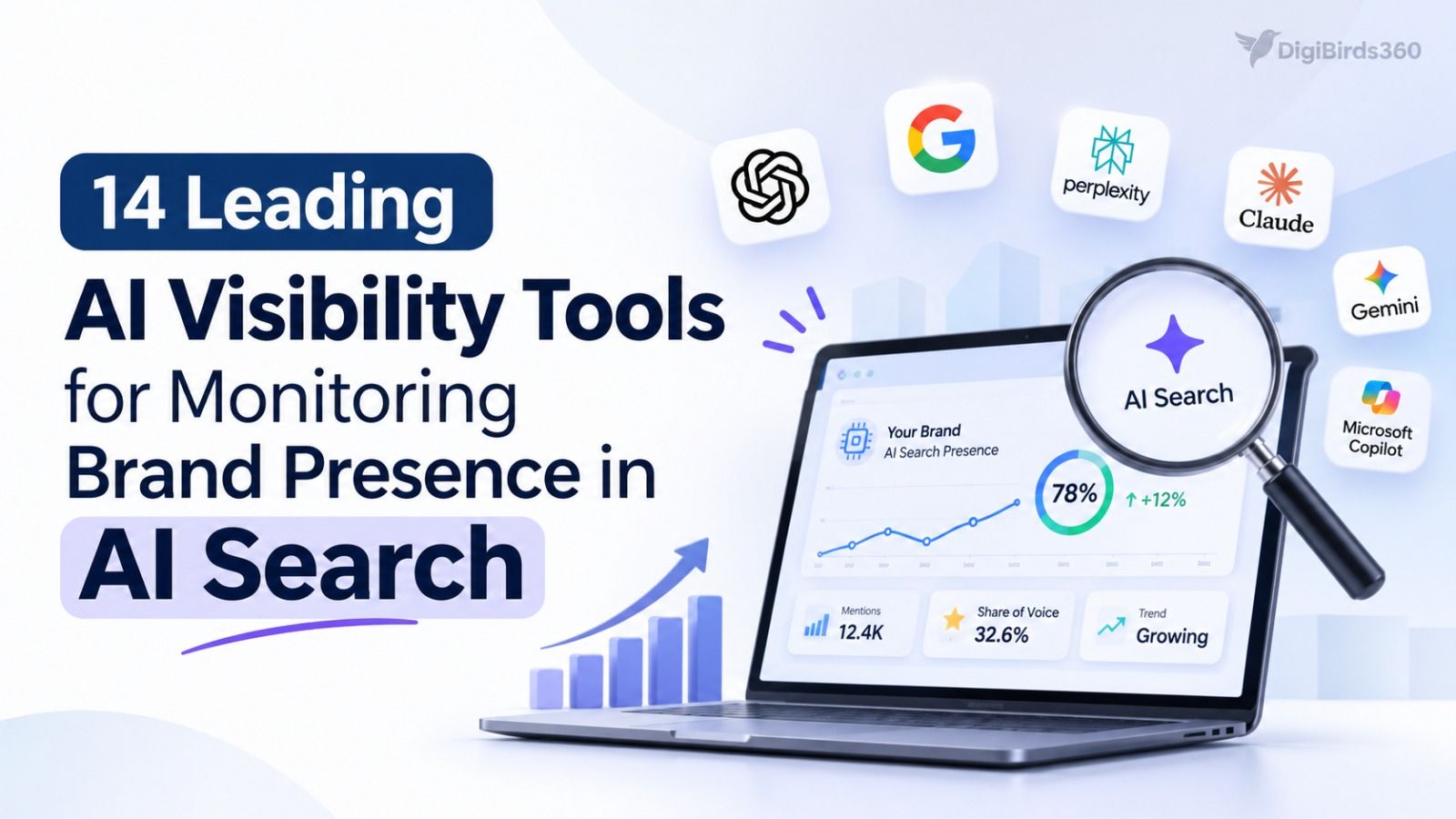
Buyers increasingly ask ChatGPT, Gemini, Perplexity and Google’s AI Overviews for recommendations before they click a single result. Bain & Company research found that roughly 80% of consumers rely on AI-written summaries for at least 40% of their searches, and about 60% of searches now end without a click. AI visibility tracking now sits beside rank tracking in most SEO reports.
This DigiBirds360 guide profiles 14 leading tools and explains how a visibility score works.
What AI Visibility Tracking Measures
These tools send a set of prompts to AI engines on a schedule and record the answers: whether a brand is mentioned, its average position, share of voice, sentiment, and the sources cited. A mention shows an engine knows a brand; a citation shows which page earned it. Answers vary between runs, so effective AI visibility tracking reports trends over weeks, not screenshots.
How a Visibility Score Works?
Vendors compress reach and prominence into one index, often scored 0 to 100, that blends how often a brand appears with where it sits in the answer. Understanding how a visibility score works also means knowing that formulas differ: a 62 in one tool is not comparable with a 62 in another. Compare movement inside a single platform and read the prompt-level detail.
Why The Collection Method Matters
Some tools collect answers through real browser sessions; others rely on API calls or reconstructed responses, which can differ from what buyers actually see. SE Visible and Profound both describe using real interfaces, so it is worth asking each vendor which method it uses.
14 Leading AI Visibility Tools at a Glance
Entry prices vary by source, plan and billing cycle, so confirm them on each vendor’s site.
- Profound: Enterprise-focused. A 7-day trial covers three engines at 50 daily prompts; Enterprise adds up to nine engines, SSO/SAML and API access. It collects answers from real interfaces.
- Scrunch: Starts at $250 a month for 125 prompts. Prompts can be organised by persona, location and funnel stage, and Enterprise covers nine LLMs.
- Semrush AI Toolkit: $99 a month for 25 prompts and one domain, with no free trial. It adds prompt research with topic volume and difficulty beside existing SEO data.
- Ahrefs Brand Radar: Reported between $129 and $199 a month. It draws on a large AI index and tracks share of voice, citations and Reddit and YouTube signals.
- SE Visible: $99 a month for 200 prompts and three projects, with a 10-day trial. It tracks ChatGPT, Gemini, AI Mode and AI Overviews through real browser sessions.
- Peec AI: Roughly $89–95 a month for 50 prompts, three engines of your choice and unlimited users. Prioritised recommended actions come on every plan.
- Otterly.AI: From $29 a month for 15 prompts, with a GEO audit covering 20-plus factors. Standard is $189 a month for 100 prompts.
- Rankscale: From about $20 a month on a credit system. It reports visibility score and average position, and includes page audits and citation analysis.
- ZipTie: About $35 a month with a 7-day trial. It runs URL-level audits for AI crawler access and suggests next actions.
- Writesonic: $99 a month for 50 prompts across ChatGPT, Gemini and Google AI Overviews. Tracking sits beside content drafting; sentiment starts on the Growth plan.
- AthenaHQ: A free tier with 300 credits; Starter is $295 a month for 3,600 credits and 11 models. It turns visibility gaps into content and outreach tasks.
- Chatbeat: From $99 a month with a 14-day trial. It reports a 0–100 brand score, share of voice, sentiment and key sources across eight-plus engines.
- Similarweb: Pricing is not published. It links AI visibility to referral traffic; brands recommended in ChatGPT answers were 2.5 times more likely to receive a visit within seven days.
- Amplitude AI Visibility: Free on every plan, with ChatGPT and Google AI Overviews confirmed. It ties visibility to product usage and revenue.
Choosing the Best AI SEO Tools
The best AI SEO tools match the job. Suite users can add tracking inside Semrush or Ahrefs, content teams may prefer Writesonic or AthenaHQ, and technical teams may favour ZipTie or Otterly.AI.
For GEO and AEO tools for agencies, seats and cost per prompt matter most: Peec AI includes unlimited users and SE Visible offers 200 prompts at entry. Check how many engines the entry plan covers, since Claude and Copilot are often add-ons. Trial two tools on the same prompts and compare trends rather than single results.
Where GEO and AEO Fit
GEO and AEO describe the optimisation work; the tracking tool is the measurement layer. AI answers lean on what already ranks: in one study of AI Overviews in France, 60.46% of cited pages came from the organic top 10. For generative AI marketing, measurement and execution need to sit together.
DigiBirds360 pairs the two; its published Emeritus case study reports a 442% increase in AI search visibility and 3.6 million AI mentions.
Conclusion
Tracking tells you where your brand stands in AI answers; optimisation is what moves it. To turn these insights into rankings, citations and leads, explore our SEO services, see how we work in our client case studies, or read our guide on how to measure content marketing ROI.
Ready to improve your visibility in search and AI answers? Partner with DigiBirds360, a trusted SEO company in Faridabad, and contact our team to get started.
References
- The 12 Best AI Visibility Tools for 2026 (Brand24): tool coverage, score approaches and the Similarweb traffic finding
- 10 Best AI Visibility Tools (SE Visible): plans, pricing, collection methods and the Bain and France study figures
- Bain & Company: consumer reliance on AI search results: 80% and 60% figures
- SE Ranking: AI Overviews study (France): top-10 citation share and YouTube share
- Similarweb: the downstream impact of AI visibility: 2.5x site-visit finding
- DigiBirds360 homepage and Emeritus case study