
Most marketing plans don't fail because of a lack of ideas. They fail because there are too many of them. A brand runs Instagram, LinkedIn, YouTube, Google Ads, WhatsApp and email all at once, talks about ten different benefits, and tries to reach everyone. The budget spreads thin, the message gets blurry, and nobody can tell what is actually working.
The 3-3-3 rule in marketing fixes this by forcing focus. In this guide, the DigiBirds360 team explains what the rule means, the four ways marketers use it, a worked example, and how to apply it to your own business step by step.
What Is the 3-3-3 Rule in Marketing?
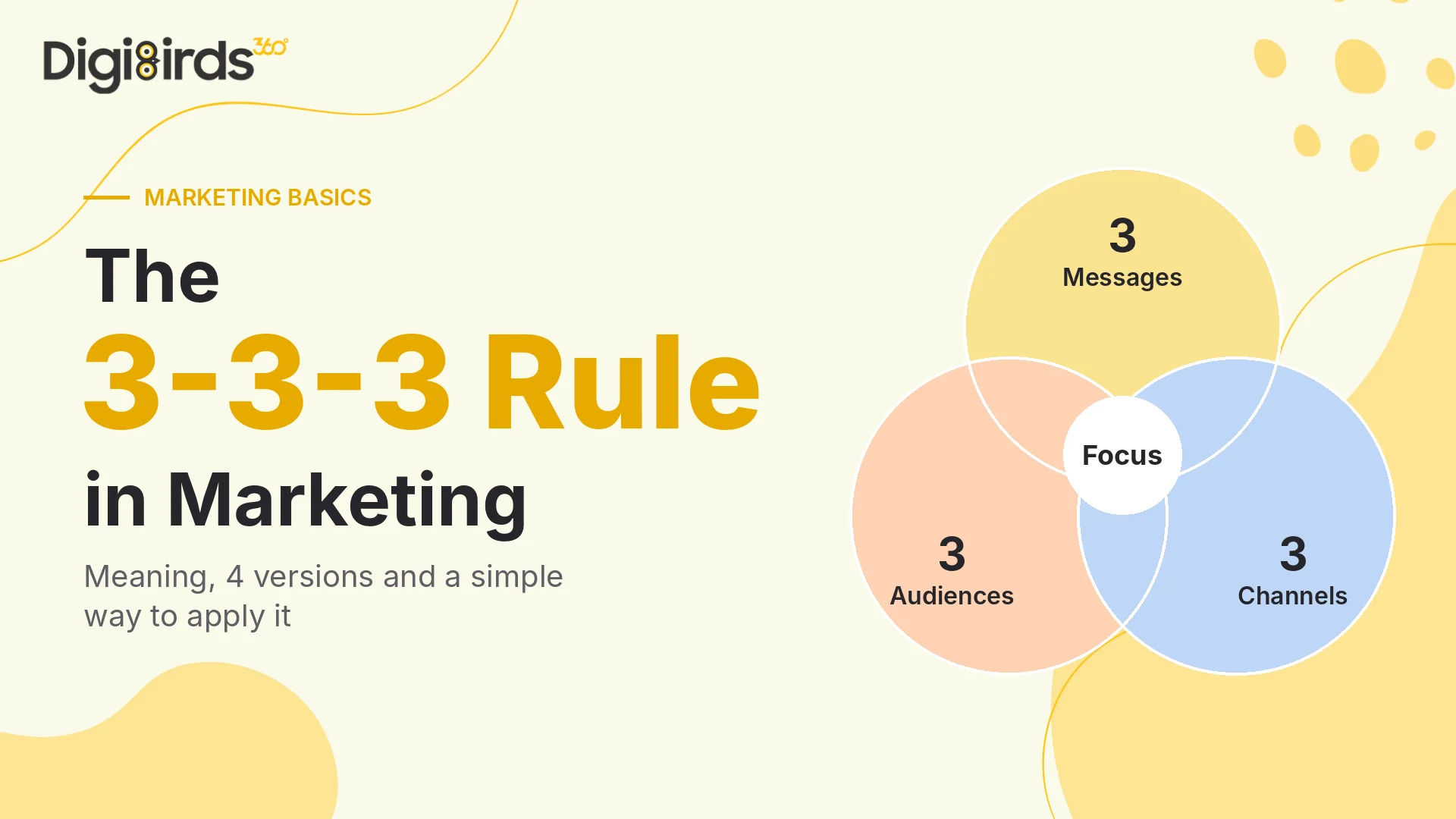
The 3-3-3 rule in marketing is a framework that limits your focus to three choices in three areas. In its most common form, that means:
3 core messages: the three things you want customers to remember about your brand
3 target audiences: the three customer segments that matter most to your growth
3 marketing channels: the three platforms where those audiences actually spend their time
Everything outside those nine choices waits until the first nine are working. The number three isn't magic. It is simply enough to give you options and few enough for a small team to execute well. The real idea is that constraints force better decisions.
The 4 Versions of the 3-3-3 Rule
There is no single official definition. Marketers use the same name for a few different frameworks, so it helps to know which one you are talking about.
Messages, audiences and channels
This is the version most people mean. You pick three messages, three audience segments and three channels, and build your overall strategy around them. Use it when you are planning a new quarter, launching a product or resetting a marketing plan that has become scattered.
Content types, channel types and buyer stages
This version shapes your content calendar:
3 content types: educational content that builds trust (guides, blogs, webinars), inspirational content that builds connection (case studies, testimonials) and entertaining content that earns attention (short videos, behind-the-scenes posts)
3 channel types: owned media (website, blog, email list), earned media (reviews, press, word of mouth) and paid media (search and social ads)
3 buyer stages: awareness, consideration and decision
The follow-up rule
When a lead shows interest, reach them through three channels, three times, within three days. For example, an email the same day, a call the next day and a WhatsApp or LinkedIn message on day three. Leads usually go cold because of silence, not rejection.
The attention rule
This version applies to individual ads, reels and videos. You have roughly three seconds to hook someone, a short window to deliver one clear message, and you need to reinforce that message in later content.
The rest of this guide focuses on the first version, because it shapes everything else.
Why the 3-3-3 Marketing Rule Works
Clearer messaging. When you repeat the same three messages everywhere, customers actually remember them.
Better use of budget. Three channels get enough spend and attention to be tested and improved, instead of six channels each getting too little.
More relevant content. Writing for three defined segments is far easier than writing for "everyone".
Cleaner measurement. With fewer moving parts, it is easier to see which message, audience or channel is driving leads and sales.
Less team burnout. Small teams can execute three channels well. Six channels usually means six half-done jobs.
A Worked Example of the 3-3-3 Rule
Say you run an interior design studio in Faridabad and want more full-home projects in the next quarter. Your 3-3-3 plan could look like this:
3 messages
End-to-end design and execution under one contract
Fixed quotes with no hidden costs
On-time handover backed by a written timeline
3 audiences
Families buying new apartments in Greater Faridabad
Homeowners planning a renovation of an older house
Small business owners setting up offices or clinics
3 channels
Instagram, for before-and-after reels and project walkthroughs
Google Search and your Google Business Profile, for people actively looking for interior designers nearby
WhatsApp, for quick follow-ups and sharing quotes
For the next 90 days, every reel, ad and follow-up uses one of these three messages, speaks to one of these three audiences, and runs on one of these three channels. At the end of the quarter, you look at the numbers, keep what worked and replace the weakest choice.
How to Apply the 3-3-3 Rule Step by Step
Pick your version. Use messages-audiences-channels for strategy, content-channels-stages for your content calendar, the follow-up rule for leads and the attention rule for ads and videos.
Start with your audiences. Look at where your best customers come from today. Each segment should need a different message or channel. If two segments would get the same campaign, merge them.
Write three distinct messages. Base them on the problems you solve, what makes you different and the outcome customers get. If two messages could swap headlines without anyone noticing, they are not distinct enough.
Choose channels based on data. Pick channels where your audience already looks for solutions, not where competitors happen to be loud. Try to cover different stages: one for awareness, one for consideration and one for conversion.
Commit for a full quarter. Give each choice at least 60 to 90 days. Frameworks fail when they are abandoned after two weeks.
Measure each choice separately. Track leads, cost per lead and conversions by message, audience and channel.
Swap out the weakest performer. Replace the one choice that is clearly not working and keep the other two.
Common Mistakes to Avoid
Treating three as a permanent cap. Once your three channels are performing predictably, you can test a fourth. The rule is about priority, not restriction.
Choosing channels that all do the same job. Three awareness channels and no conversion channel will bring traffic but few leads.
Writing messages that are too similar. "Quality service", "trusted experts" and "customer first" are the same message in three outfits.
Running the plan without tracking. Without proper attribution, you are still guessing which choices work.
Being too promotional. Most of your audience is not ready to buy today. Mix helpful content with offers so people remember you when they are ready.
Other Marketing Rules Related to the 3-3-3 Rule
The rule of 7: prospects often need to see your message several times, commonly around seven, before they act.
The 50/30/20 rule: a content mix of 50% value-driven, 30% brand and 20% promotional posts.
The 70/20/10 rule: 70% proven content, 20% new trends and 10% experiments.
The 5-1-5 rule: five pieces of content built around one core message across five channels.
These rules work well alongside the 3-3-3 framework. The 3-3-3 rule decides where to focus, and rules like 50/30/20 shape what you post once you get there.
The 3-3-3 Rule in the Age of AI Search
More customers now ask ChatGPT, Gemini or Google's AI Overviews for recommendations before they visit a website. The 3-3-3 rule helps here too. When your three core messages appear consistently on your website, social profiles, reviews and third-party mentions, AI tools are more likely to understand what your brand stands for and mention it in their answers. Clear, repeated messaging is good for people and for answer engines.
How DigiBirds360 Can Help
Choosing the right three is the hard part. At DigiBirds360, we help brands pick the messages, audiences and channels that will bring results, then execute them across SEO, social media marketing, content marketing and paid media.
Want a focused 3-3-3 plan for your brand? Get in touch with our team and we will help you build one.