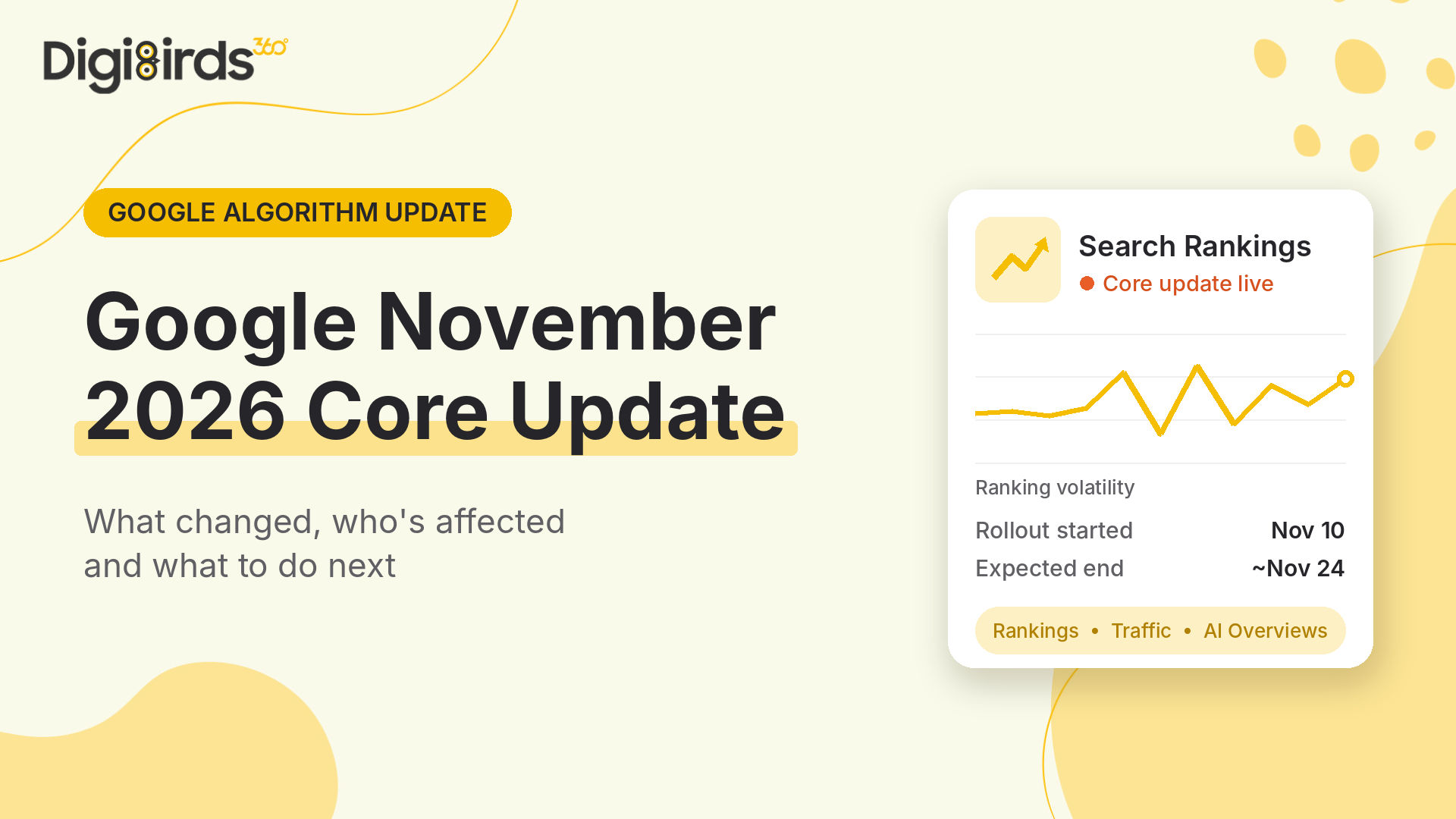
Google started rolling out its November 2026 core update on November 10. It is the third broad core update of the year, and it lands just before the busiest shopping weeks of the season.
If your rankings, impressions or traffic have moved in the last two weeks, this update is the likely reason. The good news: a core update is not a penalty, and the right response is rarely a panic rewrite.
In this guide, the DigiBirds360 SEO team breaks down what Google has confirmed, what the SEO community is seeing so far, and the exact steps we recommend before, during and after the rollout.
Quick summary
- Start date: November 10, 2026, 10:06 a.m. PT (11:36 p.m. IST)
- Impact visible from: Around November 13, based on Search Console data shared by SEOs
- Scope: Global, all languages
- Expected completion: Around November 24 (Google says up to two weeks)
- Type: Regular broad core update, not a spam update or manual action
- What to do now: Track, don't react. Analyse once the rollout is complete plus one full week.
What Google Has Confirmed About the November 2026 Core Update
Google announced the update on its Search Status Dashboard at 10:06 a.m. PT on November 10. The entry says the update applies globally and to all languages, and that the rollout may take up to two weeks.
Google Search Central also posted on LinkedIn, describing it as a regular update designed to better surface relevant, satisfying content for searchers from all types of sites. That is the same wording Google used for the March 2026 core update.
What Google has not said is just as important:
- No specific target has been named. Not AI content, not affiliate sites, not ecommerce, not link building.
- No detailed breakdown of which ranking systems changed.
- No Search Central blog post about the update at launch.
- No comment on how the update affects AI Overviews or AI Mode.
Google's long-standing position is that core updates don't target individual sites or pages. They refresh how its systems assess content as the web changes. So if a page dropped, it usually means other pages are now judged more relevant, not that yours was punished.
Google will add the update to its ranking release history page once the rollout is complete.
How It Fits Into Google's 2026 Update Calendar
This is Google's third core update of 2026 and the eighth ranking update listed on the Search Status Dashboard this year. It arrives about a month after the September spam update finished, and more than five months after the May core update.
| Update | Dates | Duration |
|---|---|---|
| November 2026 core update | Nov 10 – rolling out | Up to ~2 weeks (expected) |
| September 2026 spam update | Sep 24 – Oct 8 | 13 days, 16 hours |
| August 2026 spam update | Aug 18 – Aug 21 | 2 days, 16 hours |
| June 2026 spam update | Jun 24 – Jun 26 | 2 days, 1 hour |
| May 2026 core update | May 21 – Jun 2 | 11 days, 21 hours |
| March 2026 core update | Mar 27 – Apr 8 | 12 days, 4 hours |
Both earlier 2026 core updates wrapped up in about 12 days. November updates have historically run longer, though: November 2024 took nearly 24 days and November 2023 almost 26. So don't be surprised if this one runs past the two-week mark.
Early Impact: What the SEO Community Is Seeing
Ranking movement started slowly, then picked up. Search Engine Roundtable spotted some volatility on November 9, a day before the announcement, but most SEO chatter only began on Saturday, November 14.
Search Console data shared by Glenn Gabe suggests the update really landed around Friday, November 13, with clear surges and drops starting from that date. As of November 20, he had seen no major reversals and expected the rollout to wrap up early in the week of November 23.
It's still early, and Google hasn't named any winners or losers. But a few patterns are being reported repeatedly:
- YMYL results shifting toward informational content. Several site owners say older, thinner articles are now outranking stronger commercial pages in finance and health queries.
- Category pages being swapped out. Some ecommerce category pages were replaced by articles, filtered views or product pages from the same site, often a few positions lower.
- Scaled AI content taking hits. Glenn Gabe shared two domains that were dropping heavily after scaling up AI-generated content.
- Mixed traffic and conversions. Some sites saw traffic and Discover visits return over the first weekend. Others say conversions have dried up, and one site owner reported a drop of more than 20% week over week.
- Odd Search Console spikes. A few sites saw sudden jumps in impressions and CTR on pages that normally get almost no traffic.
- Unstable SERPs. Reddit results were reported appearing and disappearing on simple page refreshes.
Why your data might look strange right now
Before you read too much into your dashboards, keep four data issues in mind:
- Search Console is your source of truth, but it's lagging. The Performance report has been slow or unreliable for many sites in recent weeks, and Google hasn't commented. It is still more reliable than third-party tools during this rollout.
- Bot click surges can blur the picture. Earlier in November, some sites saw traffic spikes from automated agent clicks that slipped through Google's systems. Separate those spikes from genuine core update movement.
- A known AI report bug. Google confirmed a logging error that lowered impressions in Search Console's generative AI performance report for November 9 to 11. It affects reporting only, not your actual AI search visibility.
- Rank trackers are catching up. Third-party tools have been partly blocked or served "poisoned" results by Google, which muted their volatility readings. Their accuracy has improved as they filter this data out.
What to Do Now: A Step-by-Step Action Plan
The biggest mistake during a core update is making big changes based on a few days of data. Here's the approach we follow for our clients.
During the rollout
- Lock in your baseline. Export Search Console data for the week before November 10. That's the comparison point Google recommends.
- Track your key pages and keywords. If you don't already have a rank tracking project running, set one up now. New projects only collect data from the day they're created.
- Compare your swings with the market. Check your movement against an industry volatility tool such as Semrush Sensor. If everyone is moving, it's the update, not you.
- Double-check odd keyword jumps. If a keyword unrelated to a page suddenly moves, verify it in Search Console before acting on it.
- Hold off on major site changes. Don't delete pages, rewrite large sections or change every title tag based on a theory.
After the rollout
- Wait one more full week. Once Google marks the update complete, let rankings settle for at least seven days.
- Compare like for like. Put the first full post-update week against the pre-update baseline week.
- Look for patterns, not single pages. Group winners and losers by template, topic, intent and content type.
- Study who replaced you. For every page that dropped, look at the pages now ranking above it. Are they more original, more complete or a better match for search intent?
- Audit against Google's helpful content questions. Check usefulness, originality, expertise, reliability and whether the content was made for people first.
- Fix genuine technical issues. Crawl errors, indexing problems and broken internal links are worth fixing at any time.
A note for ecommerce and retail sites
If the rollout finishes around November 24, your first clean post-update week overlaps Black Friday and Cyber Monday. Holiday traffic can make performance look better or worse than it really is. Compare against the same period last year as well, not just the week before the update.
Don't Forget AI Search Visibility
Google hasn't said whether this update changes how pages are picked for AI Overviews or AI Mode. But core updates shape the pool of pages Google trusts, and that pool feeds AI answers too.
That's why we recommend tracking AI citations alongside your organic rankings during this update:
- Monitor your AI Overview and AI Mode presence for your top commercial and informational queries.
- Check where you're cited in ChatGPT, Gemini and Perplexity for the same prompts, so you can tell a Google-only shift from a wider trust problem.
- Strengthen answer-ready content. Clear definitions, direct answers near the top, FAQs and clean structured data make pages easier for answer engines to quote.
- Build real-world signals of expertise. Named authors, first-hand insights and mentions on trusted third-party sites help with both Google rankings and AI citations.
This is where AEO (Answer Engine Optimization) and GEO (Generative Engine Optimization) come in. They make sure your brand stays visible as more searches end in an AI-written answer.
Final Thoughts
The November 2026 core update is a broad refresh, not a targeted crackdown. Rankings will keep shifting until the rollout ends, and data from Search Console and rank trackers is noisier than usual right now.
The winning move is patience plus preparation: lock in your baseline, track carefully, and save the real analysis for when the dust settles. Then focus on what Google has always rewarded, which is original, helpful content that fully answers the searcher's question.
Seen a drop or a jump since November 10? The DigiBirds360 team can audit your rankings, content and AI search visibility, and build a clear recovery plan. Get in touch with us to get started.