What Is Search Everywhere Optimization?
Think about the last time you searched for something online. Did you type it into Google? Ask Siri? Check on ChatGPT? Request a recommendation from Alexa? Or maybe scroll TikTok for a quick answer?
If you did more than just "Google it," you are already experiencing the new reality of search. People no longer look for information in one place. They search everywhere, and that changes everything for businesses, marketers, and content creators.
Welcome to the era of Search Everywhere Optimization (SEvO).
This guide will walk you through what search everywhere optimization means, why it matters more than ever in 2026, how it differs from traditional SEO, and how you can build a strategy that helps your brand appear wherever your audience is searching.
| Metric | Value |
|---|---|
| Daily Google searches | 8.5B |
| Monthly ChatGPT users | 1B+ |
| Voice searches per day | 4.2B |
| Gen Z starts on TikTok/Instagram | 40% |
What Is Search Everywhere Optimization?
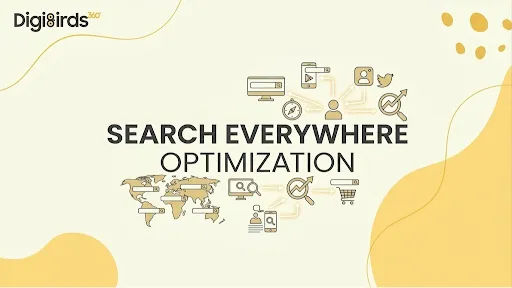
Search Everywhere Optimization (also written as SXO or referred to as internet search optimisation) is the practice of making your brand, content, and website visible across every platform and channel where people search for information, not just traditional search engines like Google or Bing.
Traditional SEO was built around one idea: rank higher on Google. For two decades, that was enough. But the search landscape has fractured.
Today, your potential customer might find you (or your competitor) through:
- Google Search (organic, maps, shopping, images)
- AI-powered answer engines like ChatGPT, Perplexity, Google Gemini, and Claude
- Voice assistants like Siri, Alexa, and Google Assistant
- Social media platforms, TikTok, Instagram, YouTube, Pinterest
- App stores (Apple App Store, Google Play)
- Review platforms like Yelp, Trustpilot, and G2
- Podcast directories and video search (YouTube is the world's second-largest search engine)
Search Everywhere Optimization is the strategic response to this fragmentation. It means optimizing your presence across all these touchpoints in a coordinated way, so that no matter where someone searches, they find you.
"Search Everywhere Optimization is not about abandoning SEO, it is about expanding it. SEO is the foundation; GEO and AEO are the new floors you build on top."
Why Traditional SEO Is No Longer Enough
For years, the SEO playbook was predictable: find keywords, build backlinks, optimize on-page elements, and wait for Google to reward you with traffic.
That model still has value, but it is no longer sufficient on its own.
1. Google's Market Share Is Slipping
For the first time in decades, Google's share of the US search market dipped below 90% in 2024, according to data from Statcounter.
Microsoft Bing, fueled by AI integration via Copilot, has been gaining ground. Meanwhile, younger demographics are actively choosing alternative platforms as their primary search tools.
2. AI Overviews Are Changing SERP Behavior
Google's own AI Overviews (formerly Search Generative Experience) now appear at the top of results for millions of queries.
When users get an AI-generated summary directly on the search page, they have less reason to click through to individual websites, a phenomenon sometimes called zero-click search.
Optimizing for traditional blue links is therefore no longer the complete picture.
3. Voice Search Has Mainstream Adoption
Over 4.2 billion voice searches occur daily. Voice queries are fundamentally different from typed queries, they are longer, more conversational, and often phrased as direct questions.
Ranking for "best coffee shops London" does not automatically mean you will surface when someone asks, "Hey Siri, where is the best coffee shop near me?"
4. Gen Z and Millennials Search Differently
Multiple studies confirm that Gen Z users turn to TikTok and Instagram to discover new brands, products, and restaurants at rates that rival Google.
If your search engine optimization strategy ignores social discovery, you are invisible to an entire generation of buyers.
Key insight: 40% of Gen Z now use TikTok or Instagram as their primary search tool for product and place discovery.
A search strategy that ignores social platforms ignores nearly half of the next generation of consumers.
SEO, GEO, and AEO Explained
Search Everywhere Optimization is built on three interconnected disciplines. Understanding each one and how they work together is the foundation of any modern search strategy.
| Feature | SEO | GEO | AEO |
|---|---|---|---|
| Full Name | Search Engine Optimization | Generative Engine Optimization | Answer Engine Optimization |
| Primary Target | Google, Bing, Yahoo | ChatGPT, Gemini, Perplexity, Claude | Voice assistants, Featured Snippets |
| Content Format | Long-form, keyword-rich pages | Authoritative, citable content | Concise, direct Q&A answers |
| Ranking Signal | Backlinks, on-page SEO, Core Web Vitals | Brand mentions, expertise signals | Schema markup, structured data |
| Output Type | Blue links in SERP | AI-generated summaries with citations | Voice spoken answer / snippet box |
| Keyword Style | Head & long-tail keywords | Topic clusters & entity-based | Conversational, question-based |
| Timeline | 3–6 months for results | Emerging, builds over time | Faster for structured content |
Pillar 1: Search Engine Optimization (SEO)
SEO is the original and still-essential discipline. It focuses on improving your website's visibility in traditional search engine results pages (SERPs), primarily on Google and Bing.
A solid SEO foundation covers three areas:
On-Page SEO
On-page SEO involves optimizing the content and HTML elements of individual pages.
This includes:
- Crafting compelling meta titles and descriptions
- Using heading tags correctly (H1 through H3)
- Incorporating keywords naturally into body copy
- Optimizing images with descriptive alt text
- Ensuring content genuinely answers user intent
Off-Page SEO
Off-page SEO is primarily about building your site's authority through backlinks, other reputable websites linking to your content.
High-quality backlinks from trusted sources signal to search engines that your content is credible and worth ranking.
Off-page efforts also include brand mentions, PR, and digital partnerships.
Technical SEO
Technical SEO ensures search engines can crawl, index, and understand your site.
Key elements include:
- Site speed (Core Web Vitals)
- Mobile responsiveness
- Clean URL structures
- XML sitemaps
- Structured data (schema markup)
- Secure HTTPS connections
- Fixing crawl errors
SEO best practice in 2026: Search engine website optimization now heavily weighs user experience signals (Core Web Vitals).
A beautifully written page that loads slowly will rank below an average page that loads instantly.
Pillar 2: Generative Engine Optimization (GEO)
GEO is the newest and fastest-evolving discipline in the search everywhere optimization framework.
It focuses on making your content visible within AI-generated responses produced by large language models (LLMs) like ChatGPT, Google Gemini, Perplexity AI, Microsoft Copilot, and Claude.
When someone asks an AI chatbot a question, the AI draws from indexed web content to form its answer.
GEO is about ensuring your content is the kind that AI systems want to cite.
Key GEO signals include:
- Authority and expertise
- Citation-worthiness
- Structured information
- Brand entity building
- Freshness
GEO is not about gaming AI systems, it is about being genuinely authoritative.
AI models increasingly favor content that reads like it was written by a real expert with real-world experience, not SEO-optimized filler.
Pillar 3: Answer Engine Optimization (AEO)
AEO focuses on optimizing content for platforms that deliver direct answers: voice assistants, Google's Featured Snippets, People Also Ask boxes, and zero-click SERP features.
The goal is not necessarily to drive clicks, it is to be the answer.
AEO-optimized content shares several characteristics:
- Answers a specific question clearly within the first 40–60 words of a section
- Uses FAQ sections with schema markup (FAQPage structured data)
- Employs conversational, natural language that mirrors how people speak
- Structures information in lists, tables, and short paragraphs for snippet eligibility
- Targets long-tail, question-based keywords (Who, What, How, Why, When, Where)
AEO and GEO are closely related, content optimized for AI citation (GEO) is often the same content optimized for voice and snippets (AEO).
Building one strengthens the other.
How to Build a Search Everywhere Optimization Strategy
Step 1: Audit Your Current Search Presence
Before building anything new, understand where you currently stand.
Conduct a full audit covering:
- Google Search Console performance
- AI visibility checks on ChatGPT, Gemini, and Perplexity
- Voice search tests using Siri, Alexa, and Google Assistant
- Social search audits on TikTok, YouTube, and Instagram
- Review platform audits
Step 2: Map Keywords Across Platforms
Keywords behave differently across search platforms.
A single topic may require different keyword treatment depending on where you are optimizing.
- Traditional SEO focuses on measurable search volume keywords.
- GEO focuses on topic clusters and entities.
- AEO targets conversational and question-based queries.
Step 3: Create Pillar Content That Serves All Three Pillars
The most efficient approach is to create comprehensive pillar content, long-form, authoritative guides on core topics.
A single well-constructed guide page can:
- Rank in Google organic results (SEO)
- Be cited in AI-generated responses (GEO)
- Appear as a Featured Snippet or voice answer (AEO)
- Be repurposed as short-form social content
Step 4: Implement Structured Data (Schema Markup)
Schema markup is the technical glue that connects SEO, GEO, and AEO.
Recommended schema types include:
- Article or BlogPosting schema
- FAQPage schema
- BreadcrumbList schema
- Organization and LocalBusiness schema
- HowTo schema
Step 5: Choose the Right Search Engine Optimization Platform
Managing a multi-channel search strategy manually is impractical.
The right search engine optimization platform significantly streamlines workflow and visibility tracking.
All-in-One SEO Platforms
Tools like Semrush, Ahrefs, and Moz Pro cover keyword research, backlink analysis, site audits, and rank tracking.
AI Visibility Monitoring Tools
Emerging tools like Profound, Brandwatch, and Otterly.AI help track AI-generated mentions across ChatGPT, Gemini, and Perplexity.
Voice and Structured Data Tools
Google's Rich Results Test and Schema.org validators ensure proper schema implementation.
Social Search Analytics
Platform-native analytics tools help monitor social search performance and visibility.
Optimizing for Each Search Channel
Google Search: On-Page and Technical Excellence
- Target featured snippet positions
- Optimize for Core Web Vitals
- Build topical authority
- Earn high-quality backlinks
- Keep meta titles optimized
AI Search (ChatGPT, Gemini, Perplexity): GEO Tactics
- Publish original data and research
- Include author bios and credentials
- Get mentioned on authoritative websites
- Write structured and factual content
- Update content regularly
Voice Search: AEO Tactics
- Target question-based queries
- Write concise FAQ answers
- Optimize Google Business Profile
- Use conversational language
- Aim for Featured Snippet positions
Social Search (TikTok, YouTube, Instagram)
- Use keywords naturally in captions and audio
- Optimize thumbnails and titles
- Post consistently
- Use platform-native indexing features
- Repurpose pillar content into short-form media
Measuring Success Across All Search Channels
Multi-channel search optimization requires a multi-channel measurement approach.
Relying solely on Google organic traffic gives an incomplete picture of overall search visibility.
Key Metrics to Track
- Organic traffic and keyword rankings
- AI mention frequency and sentiment
- Voice search market position
- Social search impressions and reach
- Featured Snippet ownership percentage
- Brand search volume trends
- Zero-click SERP impression share
Building a Unified Search Dashboard
The most effective teams build a single dashboard aggregating signals from all channels.
Tools like Looker Studio can pull data from Google Search Console, Google Analytics 4, social platforms, and third-party SEO tools into a unified reporting environment.
This allows organizations to identify which content performs across multiple channels and where optimization gaps exist.