What is Traditional SEO?
Search engine optimization is the practice of optimising websites to improve organic visibility on search engines such as Google and Bing. The goal is simple: rank higher for relevant keywords and attract organic traffic.
Traditional SEO generally focuses on three core pillars:
1. On-Page SEO
On-page optimization ensures that webpages are relevant to specific search queries. Key tactics include:
- Strategic keyword placement in titles, headers, and content
- Optimised meta descriptions and structured headings
- High-quality, informative content
For example, if a website targets the keyword “digital marketing services,” the phrase and its variations must appear naturally throughout the page.
2. Off-Page SEO
Off-page SEO builds authority and trust. This is primarily achieved through backlinks and digital mentions from reputable sources.
Research shows that pages ranking in Google’s top positions often have 3–5 times more backlinks than lower-ranking pages. These links act as signals of credibility to search engines.
3. Technical SEO
Technical SEO optimization ensures search engines can crawl and index a website efficiently. This includes:
- Mobile optimization
- Fast loading speeds (ideally under 3 seconds)
- Secure HTTPS connections
- Structured site architecture
Together, these practices help improve rankings, traffic, and click-through rates.
SEO performance is measured using:
- Keyword rankings
- Organic traffic growth
- Click-through rate (CTR)
- Conversion rate
For over 20 years, this model has driven measurable ROI. However, user behaviour is shifting. AI platforms now summarise information instead of listing links.
What is Generative Engine optimization (GEO)?
Generative Engine optimization focuses on optimising content so AI platforms reference or cite it when generating responses.
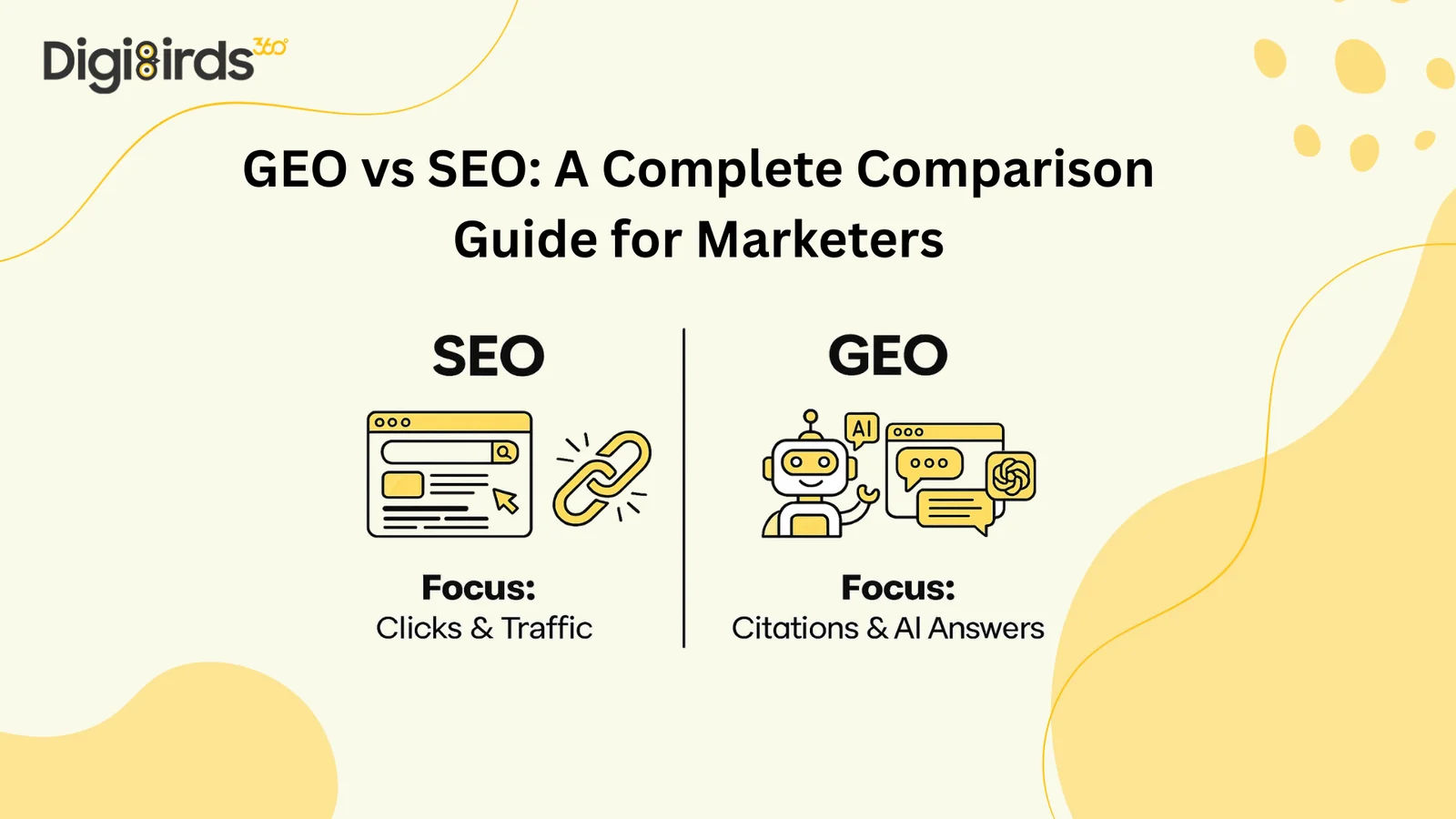
Unlike traditional SEO, which aims to rank on SERPs, GEO aims to become a trusted source for AI-generated answers. Instead of competing for position #1 on Google, businesses compete to be the information that AI systems rely on.
Key characteristics of GEO include:
- Optimising content for conversational queries
- Providing detailed, authoritative explanations
- Structuring information so AI models can easily interpret it
A recent academic study suggested that structured content with citations and statistics can increase the likelihood of AI referencing a source by up to 40%.
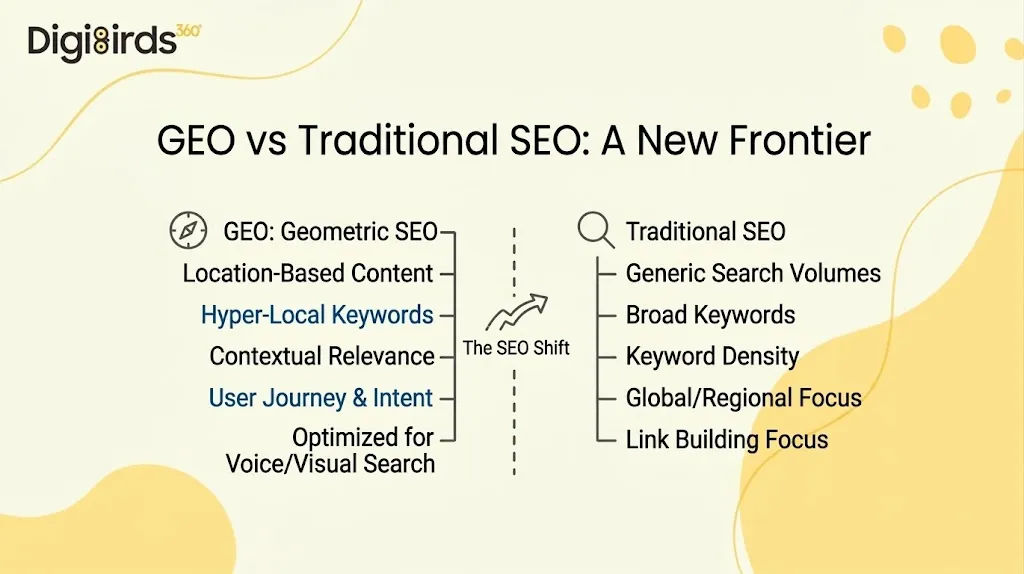
GEO vs SEO: Key Differences
Understanding GEO vs SEO requires examining how these two approaches differ in strategy, platforms, and success metrics.
1. Target Platforms
The primary SEO vs AI distinction lies in the platforms they target.
- SEO focuses on traditional search engines such as Google, Bing, and Yahoo. These engines display ranked lists of links.
- GEO targets AI-driven tools like ChatGPT, Gemini, Claude, and Perplexity that generate direct answers.
Instead of ranking links, AI platforms synthesise information from multiple sources.
2. Strategy Focus
Traditional SEO emphasises keywords and backlinks. GEO emphasises semantic clarity, authority, and conversational formatting.
This highlights the difference between SEO strategy and SEO execution:
SEO Strategy:
- Keyword mapping
- Content clusters
- Backlink acquisition
SEO Execution:
- Technical optimization
- Ranking improvements
GEO Strategy:
- Authority building
- Structured knowledge design
GEO Execution:
- Conversational content engineering
- AI citation readiness
SEO asks, “How do we rank?”
GEO asks, “How do we become the chosen answer?”
3. Content Structure and Intent
SEO content often targets specific search intent categories: informational, transactional, or navigational.
GEO goes deeper. AI engines interpret:
- Context
- Semantic relationships
- Follow-up query probability
For example, traditional search queries average 3–4 words. AI conversational queries average 15–25 words. This requires expanded content depth and structured explanation.
In the debate of SEO vs AI, AI prioritises:
- Contextual richness
- Entity relationships
- Structured formatting (FAQs, bullet points, schema markup)
4. Measurement Metrics
SEO Metrics:
- Organic sessions
- SERP ranking position
- CTR and conversion
GEO Metrics:
- AI citation frequency
- Brand mentions in generative responses
- Share of voice across AI platforms
SEO typically drives higher direct traffic. GEO drives higher authority perception. Studies suggest AI-driven answers may reduce organic clicks by 15–25%, yet increase brand recall and trust.
5. Tools
Traditional SEO relies on platforms such as Ahrefs and Semrush for keyword research and backlink tracking.
GEO tools are emerging and focus on:
- AI citation tracking
- Conversational optimization scoring
- Semantic content audits
Increasingly, SEO tools are integrating AI visibility dashboards to bridge both worlds.
Strategic Shift: SEO vs AI
The rise of AI-powered search highlights the broader debate of SEO vs AI. While AI platforms are changing search behaviour, they are not replacing traditional search engines entirely.
Instead, digital marketing is evolving toward hybrid strategies.
For example:
- Google still processes over 8.5 billion searches per day, making SEO essential for traffic generation.
- AI assistants are growing rapidly as users prefer conversational answers.
Businesses must therefore integrate both approaches to remain competitive.
Why Businesses Need Both GEO and SEO?
Rather than viewing GEO vs SEO as competing strategies, organisations should treat them as complementary.
A hybrid approach typically includes:
- Using SEO to capture traditional search traffic
- Using GEO to appear in AI-generated responses
- Creating authoritative, long-form content optimised for both platforms
- Structuring information with clear headings, FAQs, and data points
This combined model increases digital visibility across both SERPs and AI ecosystems.
Practical Business Implications
For organisations, GEO vs SEO is not a choice; it is a hybrid opportunity.
Businesses should:
- Expand content depth by 25–40%
- Incorporate structured FAQs aligned with conversational queries
- Use authoritative references and statistical validation
- Strengthen E-E-A-T (Experience, Expertise, Authoritativeness, Trustworthiness)
- Monitor AI brand visibility alongside search rankings
At Digibirds360, we recommend a dual-layer optimization framework:
Layer 1: Maintain strong SEO foundations for traffic
Layer 2: Implement GEO enhancements for AI discoverability
Will GEO Replace SEO?
No. SEO continues to generate significant web traffic globally. However, AI-driven discovery is projected to grow rapidly through 2030.
The future is not SEO vs AI, but SEO integrated with AI.
Organisations that adapt early will benefit from:
- Reduced dependence on paid advertising
- Increased brand authority in AI conversations
- Multi-channel digital visibility
At last, the debate around GEO vs SEO reflects a major transformation in how people access information online.
Traditional SEO focuses on ranking webpages through keywords, backlinks, and technical optimization.
Generative Engine optimization, on the other hand, focuses on ensuring AI platforms reference your content when answering user queries.
The key difference between SEO strategy and SEO execution lies in the shift from link rankings to knowledge citation.
SEO optimises for search engines, while GEO aligns with AI-driven information delivery.
Forward-thinking agencies like Digibirds360 recognise that the future of digital visibility lies in integrating both strategies.
Businesses that combine SEO foundations with GEO innovation will be best positioned to succeed in an increasingly AI-driven search landscape.