
The way people search is changing fast. For years, marketers focused only on ranking on Google. But now AI tools like ChatGPT, Perplexity, Gemini, and Google's AI Overviews are answering questions directly-and a new term has entered the picture: GEO. So if you're wondering what GEO vs. SEO actually means and which one your brand needs, this guide breaks it all down in simple terms.
What Is the Difference Between GEO and SEO?
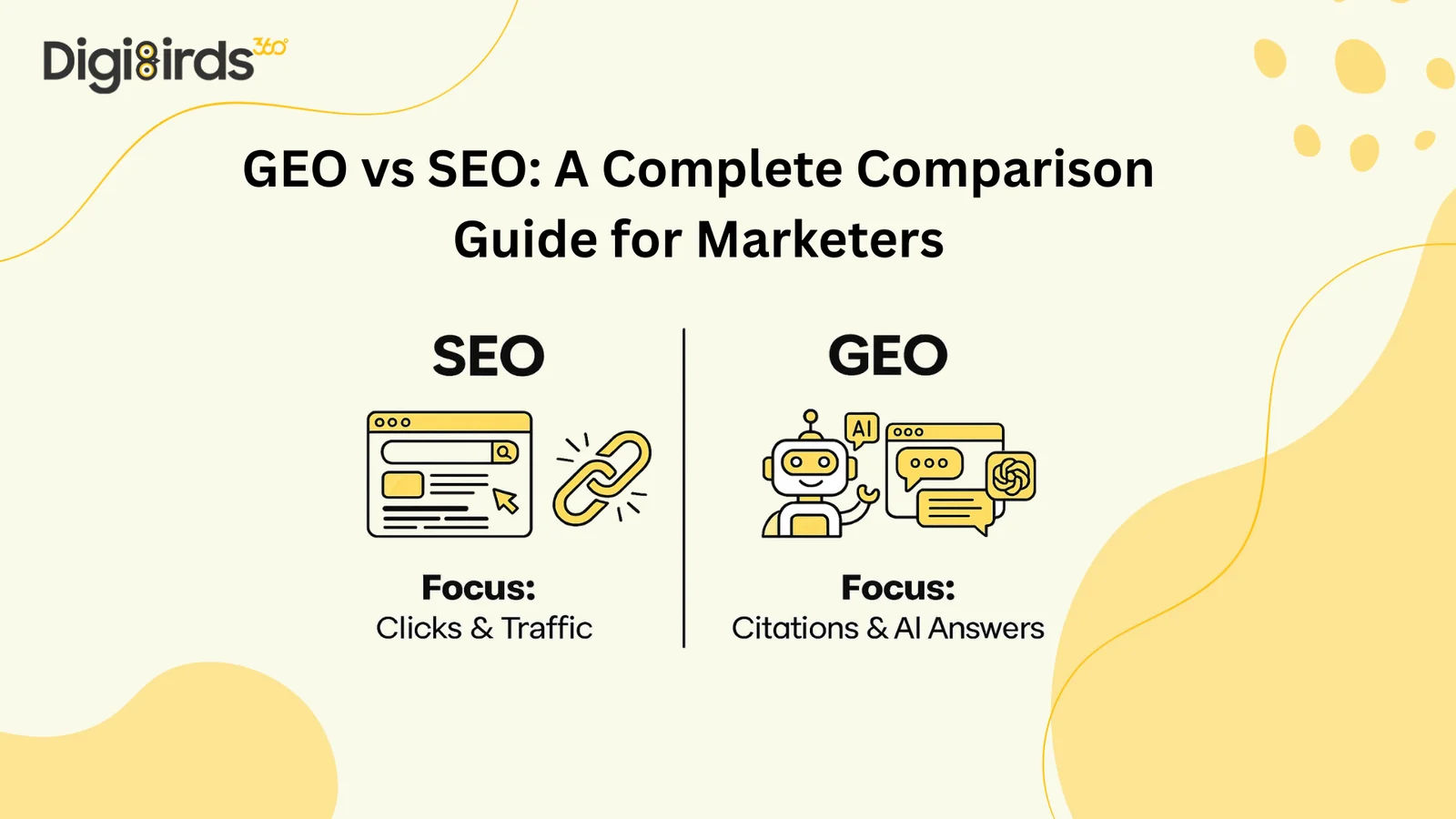
SEO helps your content rank on search engines, while GEO helps your content get cited inside AI-generated answers. In short, SEO drives clicks to your website through ranked links, and GEO gets your brand mentioned or recommended when someone asks an AI tool a question. Both are about visibility -they just work on different platforms and are measured in different ways.
That's the quick answer. Now let's look at each one a bit more closely.
What Is SEO?
SEO (Search Engine Optimization) is the practice of improving your website so it ranks higher in traditional search results and brings in more organic traffic. When someone types a query into Google or Bing, SEO is what helps your page show up in that list of blue links.
It works through a mix of things - keyword research, on-page optimization like titles and headings, internal linking, schema markup, and earning backlinks from other trusted sites. SEO has been around for over two decades, and it still works really well. It was simply built for a world where people click links to find their answers.
What Is GEO?
GEO (Generative Engine Optimization) is the practice of structuring your content so AI tools are more likely to mention, cite, or recommend it inside their answers. Instead of ranking a page, the goal is to become one of the sources the AI pulls from when it builds a response.
AI engines don't just match keywords. They read content, pick out the useful facts, and synthesize a single answer for the user. So to do well with GEO, you need factual, clearly written content that an AI can easily understand and quote, plus a trustworthy presence across the web.
Why Does GEO Matter Now?
GEO matters because AI answers are quietly replacing clicks, and if your content isn't included in those answers, fewer people will ever see it. SEO gets your content or offerings listed. GEO gets your content or offerings recommended.
Here's a simple example. If someone searches "best cordless screwdriver under $100" on Google, they get a list of products to choose from-and SEO helps you appear in that list. But if they ask ChatGPT the same thing, the AI gives a direct recommendation instead of a list, and GEO is what helps your product become that recommendation. The shift is real, too. According to Semrush's study of 10 million+ keywords, 13.14% of all queries triggered AI Overviews as of March 2025. That's up from 6.49% in January 2025-doubling in only three months.
GEO vs SEO: Quick Comparison
| Feature | SEO (Search Engine Optimization) | GEO (Generative Engine Optimization) |
|---|---|---|
| Primary Goal | Drive website traffic | Get cited in AI-generated answers |
| Target Platforms | Google, Bing, Yahoo | ChatGPT, Gemini, Perplexity, AI Overviews |
| Query Type | Keyword-based searches | Conversational prompts |
| Success Metrics | Rankings, Organic Traffic, CTR | Citations, Mentions, Share of Voice |
| Ranking Signals | Keywords, Backlinks, Domain Authority | Context, Structure, Source Credibility |
| Content Approach | Keyword-optimized, Comprehensive | Conversational, Fact-rich, FAQ-style |
Key Differences Between GEO and SEO
1. Traffic vs Citation Model
SEO measures success through traffic, while GEO measures success through citations. With SEO, you want a user to see your link, click it, and land on your page. With GEO, the AI often answers the question right there so instead of a click, your win is being the trusted source the AI quotes. a study from Bain & Company shows that 80% of users answer 40% of their queries without clicking a link.
2. Keywords vs Prompts
SEO starts with keywords people type, while GEO starts with full questions people ask. AI tools mirror natural conversation, so they prefer content that reads like a complete, trustworthy answer to a specific question rather than something stuffed with keywords. Writing the way your audience actually talks is a big part of GEO.
3. How Success Stays (Or Fades)
SEO content can stay ranked for years, while GEO content needs to stay fresh to remain cited. AI engines lean heavily toward recent, updated information. An old page that hasn't been touched slowly loses ground to a newer one covering the same topic.
How to Optimize for Both GEO and SEO
Keep Your SEO Foundation Strong
Don't ditch what's working. Solid keyword research, helpful content, clean technical setup, and quality backlinks all still matter. A strong SEO base actually helps your GEO results, since AI tools often pull from well-ranked, trusted pages anyway.
Write Clear, Answer-First Content
Lead with the answer. Put a direct, concise response right under each heading before getting into the details. Add FAQ sections with short, factual answers, and use subheadings that match how people phrase their questions-like "What Is GEO?"
Make Content Easy to Cite
Back up your claims with facts, stats, and original data where you can. Use clean formatting-short paragraphs, lists where they make sense, and clear definitions. The easier it is for an AI to lift a useful chunk out of your page, the more likely you'll get cited.
Build Trust Across the Web
AI tools don't only look at your website. They also check sources like Wikidata, Crunchbase, and LinkedIn to figure out who you are and whether you're credible. So keeping your brand info consistent across the web matters just as much as your on-page work.
A Few Quick Tips Before You Go
Track the right things-traditional traffic numbers won't show your full GEO story, so start watching how often your brand appears in AI answers and how you compare to competitors. Be patient too; GEO usually takes a few months of steady effort before you see real movement. And don't treat the two as rivals. Good SEO supports your AI visibility, and good GEO habits often lift your regular rankings as well.
Final Thoughts
Search isn't just about being found anymore it's about being trusted and recommended by AI tools too. SEO isn't going anywhere, but GEO is becoming a real part of the game, and the brands that adapt early will have a clear edge over the ones that wait. The smartest move is simply to do both well.
If juggling all of this feels like a lot, that's totally normal-there are plenty of moving parts. Our team at DigiBirds360 helps businesses get found on both Google and AI search, so if you'd like a hand sorting out your strategy, feel free to reach out.